This year Samhain will fall on Tuesday October 31st and continue through Wednesday November 1st. If you’re not familiar with this Celtic Holiday, you will probably need to know how to pronounce it correctly. I grew up pronouncing it in the Irish way (Sow-in) but it’s English pronunciation is Sah-win, and is a perfectly acceptable way to say it. Whatever you say, it’s certainly not pronounced how it’s spelled!
Samhain is my favorite of all the Pagan sabbats. It melds many of my favorite things into one celebration. The end of the Harvest season, and the mark of a new year. The utilizing of fall/autumn colors, foods, smells, etc, and the bringing in of cooler weather. Lots of magic and a thin veil between the worlds… So many wonderful and exciting things to look forward to!
A Brief History of Samhain
Samhain is a Gaelic word that in modern Irish means “Summer’s End”. This celebration is Pagan and originated from Celtic spirituality. It is one of the four Celtic Fire Festivals and Greater Sabbats, and was originally celebrated in Ireland, Scotland and in the Isle of Man. It would later be brought to America most likely by Irish immigrants.
The Celts marked it as their new year, and it was believed to be a symbol of death and rebirth. It was originally celebrated by the lighting of communal bon fires in which each household would let the flames in their home hearths go out, and bring in a new flame from the communal bonfire to light a new fire in their home as symbolic of a new cycle.
It would also eventually adopt the belief that on October 31st the veil between the living and the “other worlds” would become thin allowing spirits, fairies, and other-worldly creatures and monsters of Celtic folklore to roam freely for a night. To scare off unwanted spirits or creatures, farmers started carving faces into Turnips and calling them “Jack O lanterns”. Later the pumpkin would become more favored for this tradition.
Children would dress up as goblins and ghouls in order to trick or scare off unwanted entities. They would parade around town going door to door getting payment of treats for their “work” in keeping the village safe. If there was a house that didn’t give treats, tricks would ensue and would be blamed on fairies or spirits.
In 609 AD Pope Boniface IV would attempt to change and move Samhain to May 13th and deemed it a day to celebrate Saints & Martyrs. It didn’t really catch on and so later in the mid 8th Century, Pope Gregory III would move it back to November 1st declaring it “All Saints Day” with the following day being “All Souls Day”.
In order to compete with the popularity of Pagan practices, they adopted some of the old traditions giving them new Christian meanings which are mostly what we have come to know as modern Halloween practices and traditions.
Now let’s get to the fun stuff!
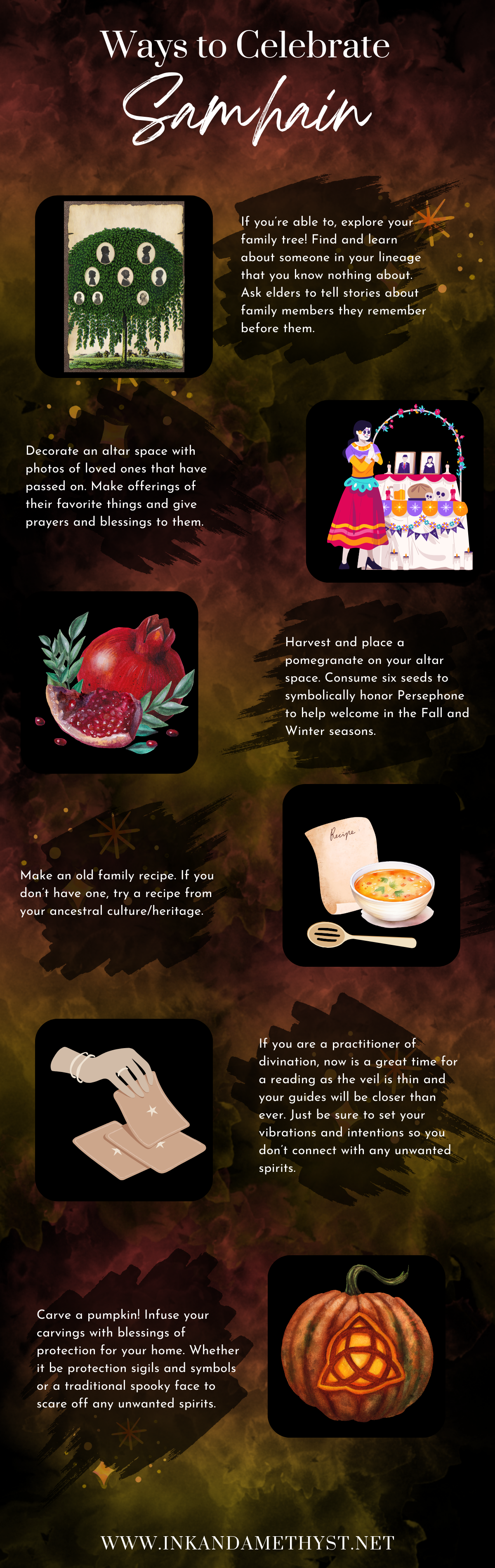
Because the veil between worlds is thin, Samhain is the perfect time to communicate with the spirits of ancestors and departed loved-ones. This doesn’t have to be spooky! At the very least, use it as a time to express your love and gratitude for them. Say all the things you wish you could say if they were here. Honor them by displaying your favorite photos on an altar, lighting candles and presenting their favorite treats when they were earth bound.
Twenty Four years ago I started my own family tradition with my kids as they were growing up. As soon as we started putting up Halloween decorations we would set up a Samhain altar. The first week we would put out photos of those close to us that have departed. As the month went on we would go on nature walks and collect fun things to add to the altar. Feathers, sticks, bones, lovely dead insects, leaves, berries, acorns, rocks, and whatever fun things that spoke to us. Then whenever the thought would strike us, we would leave treats and offerings on the table as well. My kids always thought it was magical to watch a glass of wine slowly shrink in its’ glass as the weeks went on. Though it was just likely evaporation, for them it was surely the nearby spirits!
Later as my kids got older we would have a beautiful tea-party. Days before we gathered for it, everyone would choose someone from our ancestor tree to honor. This means they would talk to their grandparents or do some genealogy and zero in on someone they were excited to know more about. We learned some amazing family history this way as they would present their honored family member and tell stories about them during the tea party. Before the end of the tea party we would all write messages to our loved ones that would sit on the altar until November 1st in which I would ceremonially burn them in my incense cauldron and clean up the altar.
Here are some other great ways to celebrate Samhain:
Symbols and Things Associated with Samhain
Herbs, plants and foods associated with Samhain include:
Rosemary, Garlic, Sage, Marigold, Calendula, Chrysanthemum, Pomegranates, Apples, Squashes, Pumpkins, Gourds, Root Veggies, Roasted Meats, Mugwort, Rowan, Cosmos, Witch Hazel, Thistle, Clove, Cinnamon, Night Shades, Mandrake, Oak, Birch, Hawthorne, Allspice, Dragons Blood, Patchouli, Nutmeg, Cider, Mead, Ale, Hazelnuts, and Pecans.
Gods associated with Samhain are:
The Morrigan, Anubis, Osiris, Yama, Hel, Freya, Persephone, Demeter, Hades, Cernunnos, Hecate, Dagon, Ceridwen, Mercury, Pachamama, Autumnus, Inanna, and Dionysus.
Crystals associated with Samhain are:
Jasper, Calcite, Obsidian, Carnelian, Opal, Danburite, Black Tourmaline, Smoky Quartz, Hematite, and Labradorite.
Colors traditionally associated with Samhain:
Black, Orange, Gold, Brown, Purple, and Scarlett.
Other Cultural Traditions similar to Samhain:
Dia de los Muertos- celebrated all across Mexico, this celebration honors the dead and is celebrated on November 1st & 2nd. Much like Samhain, it’s believed that the veil between worlds is thin and thus spirits and people can intermingle.
Daimonji– celebrated in Japan, this celebration is an annual Buddhist tradition where departed souls return every August to visit their families.
Gai Jatra- celebrated in Nepal, this late summer celebration is a cow festival that honors those who have died in the prior year.
However you choose to celebrate Samhain this year I hope you have a wonderfully magic, time!
References:
 Ink & Amethyst
One response to “2023 Samhain”
[…] connections to this time of year and is the perfect flower to dive into as we celebrate Autumn, Samhain, and other cultural rituals and celebrations that happen around this […]
LikeLike